






It was December of 1994, and Tamra Davis had some time on her hands. The filmmaker had just finished directing Billy Madison, the movie that would launch Adam Sandler’s movie career, and it wouldn’t be hitting theaters for a few months. Her husband Michael Diamond, a.k.a. Mike D of the Beastie Boys, was about to take off for a series of shows in Australia. This wouldn’t be any old tour, however — their friend Stephen “Pav” Pavolic, who had worked as a promoter for the Big Day Out festival, wanted to start his own version of a Lollapalooza-style fest down under. He dubbed it “Summersault,” and had planned to take a number of groups across the continent from December through February, Australia’s traditional summer months.
The Beasties were only one of a handful of groups Pav had recruited. Sonic Youth was on the bill as well. So was Pavement, Rancid, and Beck. Kim Deal‘s side project, The Amps, had signed on. So had Dave Grohl‘s relatively new, post-Nirvana band, a solo project-turned-loose collective he called Foo Fighters. Davis knew Kim Gordon and Thurston Moore from her music-video gigs, having directed their clips for “100%” and “Bull in the Heather.” The latter featured Kathleen Hanna dancing around Sonic Youth; she had been a key part of Davis’s short “No Alternative Girls,” and Mike D had recommended her group Bikini Kill to Pav, who added them to the lineup as well.
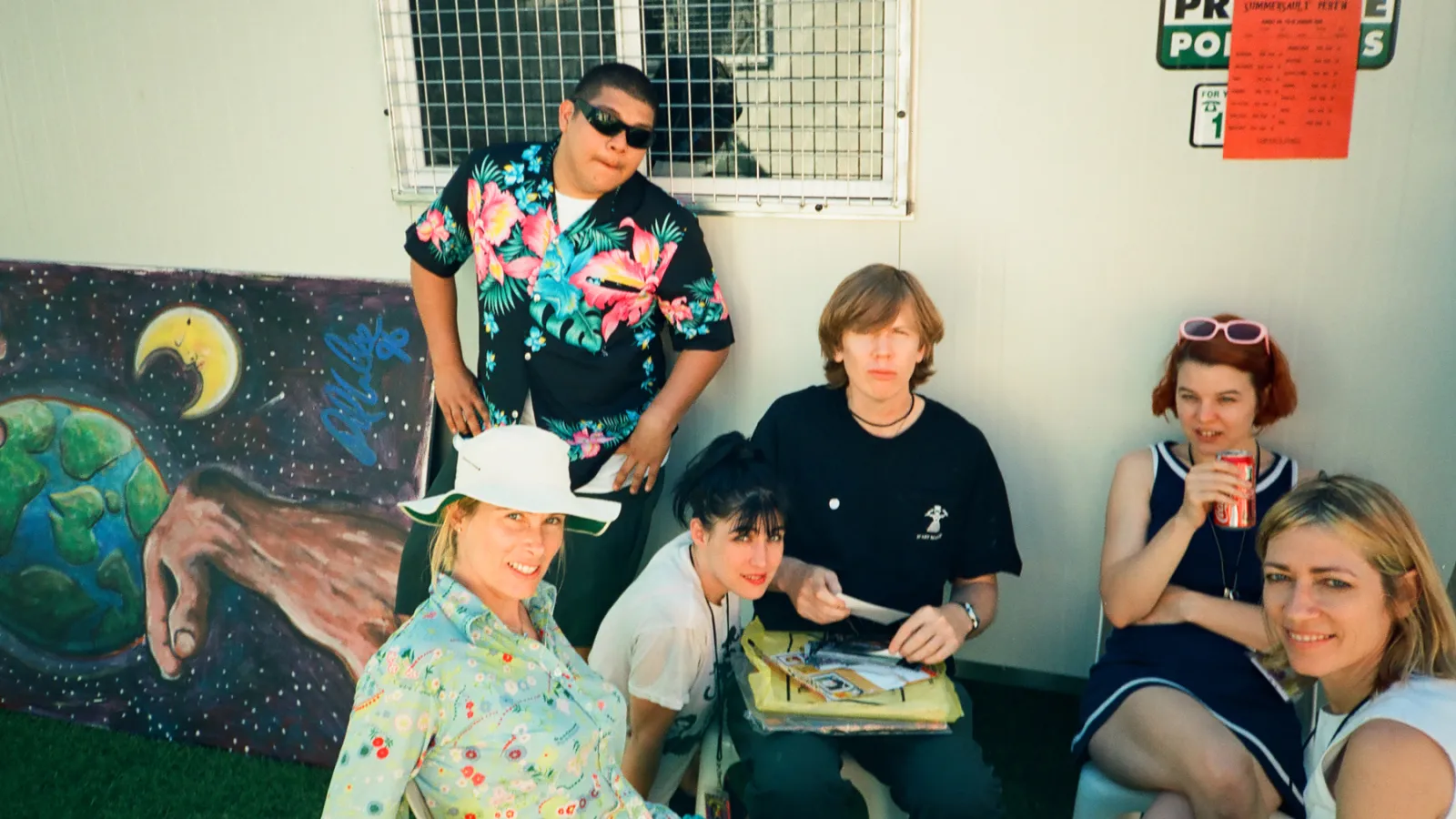
There were a lot of folks already in her orbit who’d be part of this inaugural Summersault tour. Why not tag along? Davis joined the traveling circus. And naturally, she brought her cameras along, filming not just her husband’s sets but everybody’s performances, as well as Hanna doing extremely informal interviews backstage with everyone. When the filmmaker returned home a few months later, she put the unmarked tapes in a box. And that’s where these mementos of how Davis spent her Australian summer vacation stayed for 30 years, until she was evacuating her Los Angeles home during the 2025 fires and came across her own personal time capsule.
“At first, I couldn’t even watch the tapes,” Davis recalls, sitting in the lobby of a Park City hotel a few days after The Best Summer, her concert doc-slash-tour-diary, premiered at Sundance. “I had to buy a Hi-8 camera just to see what was on them. I started zooming through them, and it was like, ‘Wait, I had all of this early Foo Fighters footage!? What is this?’
‘I mean, I was always shooting stuff back then,” she adds. “When I [produced] The Punk Singer, the doc on Kathleen, I knew I had Bikini Kill concerts from that era. And when Spike [Jonze] needed footage for his Beasties thing, I gave him everything I had and told him, ‘Yeah, use whatever, just transfer it for me.’ But I had no idea I essentially shot a whole documentary, and the quality of those backstage interviews and how everyone was being so honest and unguarded — I didn’t know I had any of that. That’s what so astounding.”
The Best Summer isn’t a history lesson on the rise of underground music, a timeline on the evolution of the multi-artist, mixed-and-matched genre tour, or a primer on the state of the alt-rock nation circa the mid-1990s. “I originally had commentary over all of it, stuff like ‘This is Dave Grohl’s new band, it’s one of their earliest shows’ — that kind of thing,” she says. “The first person I showed the movie to was Kim Gordon, who said, ‘Stop talking. It’s too distracting having your voice from the future coming into the past. Just bring me to early 1995 and keep me there. Do not take me out.’”
Instead, what we get is a very personal, very unfiltered take on what it was like to be on tour with a dream lineup of the decade’s best bands for a few months. Everyone hung out with each other and watched everybody’s sets. Davis and Hanna would “be running around, being bossy girls,” and asking Beck what his favorite color was and where he bought his underwear. (For the record: blue and Sears.) This is where Hanna met her future husband Adam Horovitz, and you see their chemistry together on camera. Davis wasn’t just friends with the musicians; she loved the music, and the performances are shot from a fan’s perspective, albeit one with an all-access pass. “Watching this now reminds me just how great Sonic Youth was live,” she says. “It’s funny, after I showed this to Kathleen, she told me, ‘I never used to like Pavement. Then I saw this, and I realized I had them all wrong. I thought they were preppy. They’re from Stockton. I listen to them all of the time now.’”
Once Davis started toying with the idea of actually turning her footage into something fit for public consumption, she immediately called up John Silva, the manager of the Beasties, the Foos, and several of the other bands. Davis asked him if he thought it’d be possible to get the music rights; his main worry, she said, was that the quality of the concert footage wouldn’t be up to snuff. “But the Aretha Franklin doc [Amazing Grace] had come out a few years before,” she says, “and supposedly the sound quality on that was horrible, and they fixed it. John basically convinced me to do it by the end of the conversation. He was like, ‘It’s going to be great. We just have to get the bands’ approval.’”
That took a bit of doing — “I don’t think I’d talked to [Rancid frontman] Tim Armstrong in almost 30 years; I had to track him down through Rick Rubin and [podcaster] Andrew Huberman” — but after Davis made a rough assemblage of the performances, first on her own and then with her editor Jessica Hernández, every one of the musicians signed off. Because she didn’t want to be beholden to notes from executives. Davis was determined to self-finance and make this as D.I.Y. as possible. “I can’t be like, ‘Oh, Netflix said, can we put in more about Kurt [Cobain]? Can we really play up the whole thing between Kathleen and Adam?’ You know, they would wanna push weird stuff. And I was like, I can’t do that. I wouldn’t do that. I took the musicians’ notes. That was what mattered to me.”
The reactions, she said, often brought tears to her eyes. “Everyone remembers this as one the best times of her life, and this took them right back there,” Davis notes. “And it was also heartbreaking. I remember [Bikini Kill’s] Toby Vail saying, ‘Nobody talks about the dead guy.’ Kurt had only been dead a year, and we were all still processing that. Kim’s watching this old footage of her and Thurston [Moore]. I wanted Dave Grohl’s best friend, Jimmy, to be in the movie. He’s no longer with us. I told Mike, ‘I just want you to know, Mikey, you’re going to see a lot of Yauch, and he’s so beautiful here, but….’
“And it was emotional for me too,” she admits. “You know, Mike and I are separated. We’re still technically married, but to see us at that time… and also, as a woman, to have the maturity to be able to look back at my past and really be happy with that. To me, that’s strength. I could have been like a bitter old lady!” Davis laughs. “But no, I love watching all of that.”

The Beastie Boys performing in 1994, several months before the Summersault tour’s kick-off.
Scott Harrison/Getty Images
She’s also happy that her sons Skyler and Davis, both of who are in the band Very Nice People, get to see their parents in a whole different light. “I love Mike and like, we still share the same house. We have kids together and, you know, they move in and out, we move in and out of the house. To show him with love is really important. It’s really strong for my boys to see that, because when I got to show them old Beastie Boys footage, they weren’t there for that. They were there later, when they were little kids. But they were just like, ‘Oh my God, Dad, you have so much energy. We can’t believe how you move.’ They never got to see him onstage back then.”
It was Mike who also encouraged Davis to extend The Best Summer past their tenure on Summersault, and include footage that she shot when the Beasties and the Foo Fighters went on an MTV-sponsored tour in Asia. The former, it should be noted, were banned from entering Singapore, so Davis and B-boys went on vacation in Indonesia. That’s where Davis filmed the Beasties smoking… something out of a makeshift tinfoil pipe.
“Yeah, when I asked everybody for notes, I kept wondering: Is Mike gonna ask me to take the drug scene out?” she says, laughing. “He liked it. He said it made them look dangerous. I mean, they are rock stars.” A pause. “It’s not like you know what it is.” Another pause. A smile. “It could be tobacco. Let’s say it was tobacco.
“When I originally started on this it, I thought it was just going to be just Australia — like, a documentary on Summersault,” Davis continues. “Then I had that Indonesian footage, and I was like, this is weird. It’s like, it’s different, it’s a little darker — is it two parts? But Mike was the one who said, ‘I like how, when you get to the footage from Asia, it starts to let you know what it’s really like on tour.’ How isolated you feel, how you’re out of your comfort zone, how you have to sneak out of hotel just to walk around, how things go wrong. And then the only people you have are your little group of people, and you get tighter and tighter with them. I feel like that’s when The Best Summer actually turned into a movie, because the Summersault bits were just so happy and fun. And then it’s like, the tour is still going. We still have more dates to do. We’re still on the road.”
And that footage, Davis notes, is where she got her favorite reaction from one of the artists. “I showed this to Adam,” she says. “When he watched what I shot in Indonesia, he pointed out a scene in which the three of them are dancing. He was like, ‘I feel like you reached into my brain and pulled out this weird memory that only I thought was mine. I was not aware you were filming. I was not aware I was on camera. I thought that was my memory, and to see that you had that…’ He said that occasionally, he would be on a random street, and all of sudden, that specific memory will come up. And he’s like, You found my memory.’ They really were best friends. It was a pure thing. And he got to relive that memory.”
It’s the candid offstage moments that make The Best Summer feel like more than just a spirit-of-94 concert movie. “Yeah, we made a time machine,” Davis says. She takes a moment to compose her thoughts before continuing. “I think the Tamra who’s in that movie would be psyched that I’m still here doing this. Because you can get so many no’s. You could be sensitive and be like, Okay, I’m gonna step back. But I was always thinking that one day, a girl’s gonna see a ‘directed by’ credit with a female name, and she’s gonna be inspired. So she would be so happy that, ‘Wow, you’re 60, you’re still making movies, and you’ve got a film in Sundance.’
“And I’d be looking back at her, like, ‘You’re so tenacious,’” she adds. “‘You weren’t shy around these musicians. You kept the camera rolling. You didn’t film part of a song, you filmed the whole thing. Thank you so much for being there.’”