





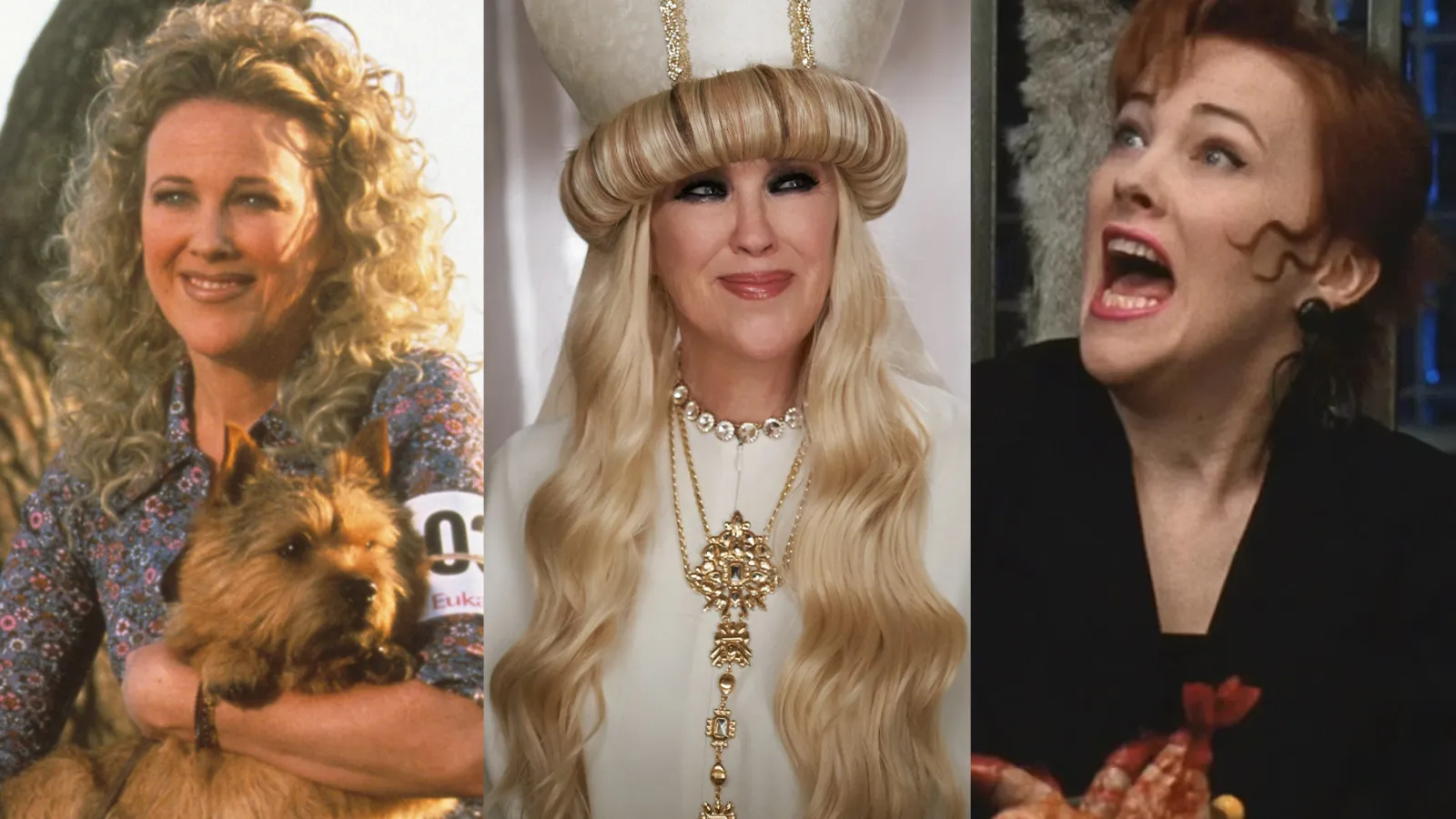

From Moira Rose to Kate McCallister, quirky dog moms to kooky folk singers, nine must-see highlights from the comic actor’s 50-year body of work
Whether in a high-concept comedy sketch — what if Katherine Hepburn turned a tea commercial into an anecdote about an afternoon delight with a stagehand? — or a slapstick sitcom about modern-day Hollywood, Catherine O’Hara had a knack for finding the perfect spin on a joke. The Canadian comedic actor was both a team player and a scene stealer, a physical performer (that Beetlejuice dance!) and someone who knew her way around a witty line. Here are our picks for the best of the late, great O’Hara’s work.
-
‘SCTV’ (1976-1984)


Image Credit: CBC/Everett Collection O’Hara had already been a part of the Second City in Toronto for years when the improv troupe came up with an idea for a TV series. It would revolve around the loose premise of a tiny TV station operating out of the small Canadian town of Melonville. O’Hara would be a key player in those early years, leaving after two seasons. She returned when the show was picked up by NBC for its fourth season — and it was in this so-called Network 90 era (when episodes expanded from 30 to 90 minutes) in which O’Hara proved herself to be the show’s MVP. It’s impossible to talk about the seminal sketch show without singling out O’Hara’s celebrity impressions (she did a killer Brooke Shields and Katherine Hepburn, and uncannily nailed Liz Taylor’s sudden way of INCREASING HER VOLUME halfway through a sentence) or recurring characters like the all-around entertainer Lola Heatherton, one of the most devastating takes on showbiz desperation. She was also responsible for writing the greatest game-show parody ever, as well as its equally hilarious sequel. It’s tough to pick a single highlight of her two separate runs on SCTV, but if we had to, our money’s on “Long Distance Call,” a masterpiece of escalating ridiculousness. —David Fear
-
‘Beetlejuice’ (1988)

Image Credit: ©Warner Bros/Everett Collection While Winona Ryder’s character Lydia got all the credit for being “strange and unusual” in Beetlejuice, her stepmom, Delia, played by O’Hara, was clearly pushed her in that direction with her bizarre sculptures, post-postmodern interior design (with help from “a little gasoline and a blowtorch”), and friendship with oddball designer Otho Fenlock. O’Hara, of course, was perfect for the role since she could play both bad and bougie, often at the same time. Her turn singing Harry Belafonte’s “Day-O” while possessed at a dinner party was a scene-stealer: Delia manages to look both shocked and thrilled by the experience. —Kory Grow
-
‘Home Alone’ (1990)

Image Credit: ©20thCentFox/Everett Collection Millennials’ introduction to O’Hara was in the Home Alone franchise, in which she played the incredibly anxious Kate McCallister, a.k.a. Kevin’s mom. She’s a devoted mother in peak Nineties fashion, yet she somehow loses track of her son (Macaulay Culkin) not once, but twice — first accidentally leaving him at home, then again in New York City — forcing him to fend off two goofy yet still menacing criminals (Joe Pesci and Daniel Stern) by himself. Her role is forever memorialized in her screaming of Kevin’s name, which she unleashes across Home Alone and Home Alone 2, and then again and again in public, whenever strangers would ask O’Hara to reenact the iconic moment for them. Culkin still referred to her as “Mama” in the decades after, particularly when she gave a speech at his Hollywood Walk of Fame star ceremony in 2024. “I thought we had time,” Culkin wrote on Instagram upon her death. “I love you. I’ll see you later.” —Angie Martoccio
-
‘Waiting for Guffman’ (1996)

Image Credit: Warner Bros Pictures. Only Catherine O’Hara could deliver a line in Waiting for Guffman’s Chinese dinner scene as perfectly drunkenly deadpan as, “Shh, girl talk: What’s it like to be with a circumcised man?” It’s a cringey conversation-killer that keeps snowballing as her husband in the movie, played by Fred Willard, offers up that he’d undergone penis reduction surgery and O’Hara says he asked her, “Why don’t you get one of those vagina enlargements?” Guffman was the first of her four feature-film collaborations with writer-director Christopher Guest (five if you count Spinal Tap II, written by Guest and directed by Rob Reiner), and it showed off her tremendous skill as an ensemble player. O’Hara and Willard played married travel agents the Albertsons hoping to get their big break as actors in Red, White, and Blaine, a play commemorating the 150th anniversary of a Missouri town. Every scene she’s in simply snaps. —K.G.
-
‘Best in Show’ (2000)

Image Credit: ©Warner Bros/Courtesy Everett C In Best in Show, her second outing with the Christopher Guest players, O’Hara is Cookie Fleck, who heads out on a road trip with her husband, Gerry (Eugene Levy), and their Norwich Terrier, Winky, to New York for the Mayflower Kennel Club Dog Show. As Cookie, O’Hara sloughs off any trace of her motherly aura from Home Alone, instead playing a subdued sexpot and former waitress who’s had “hundreds of boyfriends” and can barely get through a day without running into an old fling. (“Bulge? Get outta town!”) But instead of playing her as a one-note joke, O’Hara imbues Cookie with a genuine sweetness, with her love for her husband (and champion dog) coming through in every scene — whether she’s pushing an old boyfriend in his living room or getting cozy in the hotel storage room. —Elisabeth Garber-Paul
-
‘A Mighty Wind’ (2003)

Image Credit: Warner Bros. Pictures. There are lots of laughs in this affectionate parody (again from Guest and Co.), which attempts to do for 1960s folkies what This Is Spinal Tap did for metalheads. It’s the segments with O’Hara and Eugene Levy, however, that give the film its heart. As one half of the popular folk duo Mitch & Mickey, former lovers whose performances of the hit “A Kiss at the End of the Rainbow” always ended with a passionate smooch, she’s the one who has the most at stake in the film’s big reunion gig. When Mickey broke up the act, got married, and broke Mitch’s heart, he went around the bend and never truly recovered. What will happen when, after years of not seeing each other, they’re forced to play “Rainbow” again? And will that number end with one last kiss? Watch O’Hara’s face when she and Levy work their way up to the song’s climax. It’s a life’s worth of sorrow and love, all in a furtive glance. The duo performed “Rainbow” at the Oscars that year when it was nominated for Best Original Song. Even when you knew how this reprise would end, it still made you swoon. —D.F.
-
‘Schitt’s Creek’ (2015-2020)

Image Credit: PopTV After decades of supporting roles, O’Hara finally got a chance to show the depth of her genius and comedic range on Schitt’s Creek. O’Hara played Moira, the matriarch of the Rose family, a washed-up soap opera star who wasn’t exactly the most hands-on mother to David (Dan Levy) and Alexis (Annie Murphy) prior to losing their family fortune and moving to the dingy titular Canadian town. Moira might not remember her daughter’s middle name, but she made up for it with her fabulous, larger-than-life presence, wearing wigs made of human hair and giving vague cooking instructions like, “Fold in the cheese!” Her accent, of course, was the cherry on top, a highly sophisticated and bizarre combination of mid-Atlantic, upper-class British, and old Hollywood that viewers fell in love with — so much that O’Hara admitted that people were often disappointed to hear her speak as herself. She won several Emmys for the role, and the cult series helped introduce O’Hara to younger generations. The internet still can’t get enough of Moira’s witty one-liners, like when she asks David, “Now, will you be a doll and fetch mommy a knife? Oh, I’m sorry, I think you’ll find one lodged in the middle of my back.” They’ll live on forever. —A.M.
-
‘The Studio’ (2025)

Image Credit: AppleTV In the first episode of The Studio, we hear about O’Hara’s character Patty Leigh long before we see her. It’s quickly established that she’s a powerful veteran studio head who’s been unceremoniously fired by the company’s money men — and she’s been replaced by her insecure, people-pleasing mentee Matt Remick, played by Seth Rogen. When Patty finally appears onscreen toward the end of the episode, the wait pays off: O’Hara goes all in on a hilariously mercurial Patty, who’s been at home crying for days on end; she toggles between weepiness and rage before guilt-tripping Matt into giving her a wildly lucrative producing deal that keeps her one step ahead of him the rest of the series. O’Hara brings her own wisdom and world-weariness to the role, the sense that underneath her occasional daffiness Patty is also a sharp and gritty survivor of Hollywood’s insults and vicissitudes. Her comedic timing and ability to look positively horrified at all of Matt’s high-cringe antics (like when she desperately urges him to leave the set of a romantic comedy he’s wrecking on “The Oner” or when she tries to save him for embarrassing himself in front of Zoë Kravitz in “The Golden Globes”) ups the skin-crawling awkwardness and uncomfortableness that makes every episode so addictive — and remains one of the best performances on the show. —Julyssa Lopez
-
‘The Last of Us’ (2025)

Image Credit: Liane Hentscher/HBO One of O’Hara’s last roles was a big departure from how we normally saw her — a dramatic turn as Gail, a therapist in the Jackson, Wyoming, community of survivors of the mushroom-zombie apocalypse. She brings a deep well of sadness and resignation to her portrayal of a woman grappling with her own personal grief while treating the grief of others. There are flashes of anger, too: We learn in the course of Gail’s sessions with Pedro Pascal’s Joel that he killed her husband, Eugene (Joe Pantoliano), after Eugene became infected. O’Hara plays these moments with uncharacteristic stillness, and in her three-episode arc the directors often linger on her face. She wears Gail’s pain and loneliness as memorably as she ever did the exaggerated expressions of her most off-the-wall comedic characters. —Maria Fontoura