





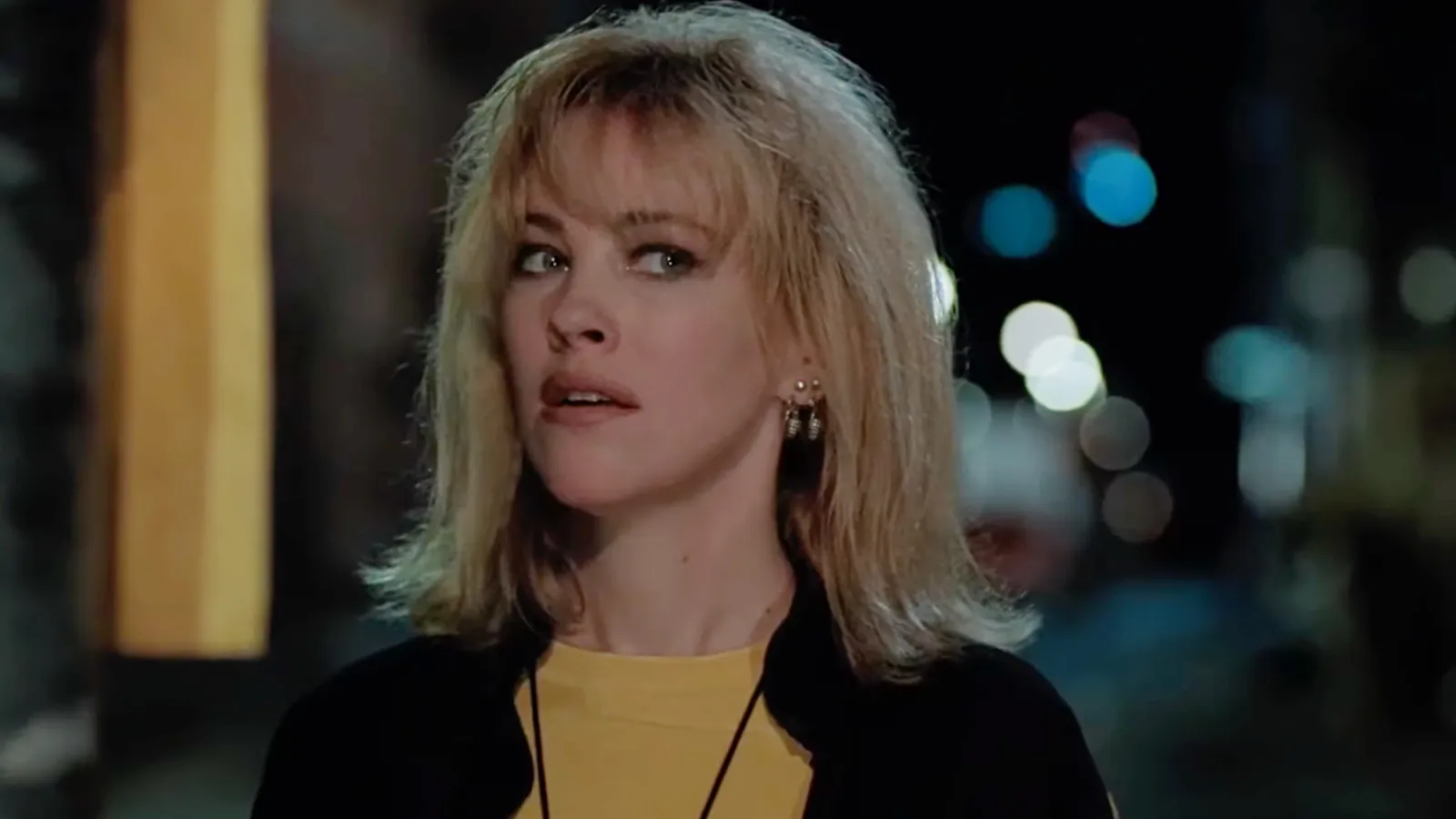

Just over an hour into the 1985 cult classic After Hours, Catherine O’Hara shows up. It’s a late night in Soho, the cobblestone streets dark and empty, and our hero, Paul (Griffin Dunne), is having a terrible time. His money gone, he can’t get home; but then, suddenly, Gail (O’Hara) appears. She kindly invites him to her apartment so he can use her phone. Yes, it’s a little odd she’s wearing a coach’s whistle around her neck, but, you know, New York in the Eighties was dangerous.
Upstairs, as Paul picks up the receiver to call a friend, relief washes over him. “You wouldn’t believe what I’ve been through tonight,” he says. Gail answers: “I’m an ice cream vendor. Mister Softee.” After a double take, Paul continues, “Oh, you misunderstood me. I didn’t ask what you did for a living.” From there, the scene continues at lunatic cross purposes: Paul tries to make his call, Gail defensively lists the merits of driving a Mister Softee truck (“It’s not boring … You need a class 4 New York State chauffer’s license. Guess who has one?”). Every time he starts to dial the phone number from memory, she spouts numbers to make him lose his place. After he confides he may have angered a bartender with a violent temper, she reads an article aloud about a gruesome crime, making sure to hit every detail — “a man was torn limb from limb” — and then stops to ask, almost sincerely, “What does a guy have to do to get his face pummeled?”
Gail is self-absorbed, destabilizing, and hilarious. It’s a classic Catherine O’Hara performance.
After Hours, which shot in 1984, marked Scorsese’s return both to New York City and to small-scale filmmaking after a rough few years in Hollywood. At the end of 1983, his latest release, the now beloved but then-despised The King of Comedy, was named the “flop of the year” by Entertainment Tonight. Soon after, Paramount Pictures, worried about budget and subject matter, pulled the funding from his next film, The Last Temptation of Christ (the movie would eventually be made in 1988). By the time After Hours came along, Scorsese had a reputation as a director who couldn’t deliver; his films were too expensive, too lofty and took too long to make. As After Hours producer and star Dunne once put it, Scorsese was in “Director Jail.”
After Hours, which takes place over one long night, follows yuppie Paul as he meets a pretty girl near his apartment uptown and decides to follow her downtown to Soho. In one unsettling encounter after another, Paul’s odyssey gets weirder and scarier, but no matter what he tries, he can’t get home. Every escape scheme blows up in his face; his milquetoast bravado, combined with an escalating exasperation and desperation, just pisses people off. The movie is increasingly dark, tense, and frantically funny.
The cast is exquisitely Eighties (the first star to sign on was Teri Garr) and showcases a murderers’ row of arty, edgy, angsty, New York-y types like Rosanne Arquette, Linda Fiorentino, John Heard, and Dick Miller. And then, there’s Catherine O’Hara. Open, warm, and bracingly Canadian, O’Hara had found fringe fame at the time in the sketch-comedy series SCTV. She was known for broad delusional characters with a loopy charm — certainly not menace — but Scorsese, a big fan of SCTV, saw something else in her.
“I remember really being pumped up by Scorsese,” O’Hara said in an Air Mail oral history of the making of After Hours. “He’d go [about Paul], ‘Who’s this little fucker? You’re the one helping him!’ He made it clear my job was to make Griffin’s character’s life hell. It’s fun when you’re given license to be bad.”
O’Hara isn’t onscreen for long, but she makes the most of every moment. And in a film with few plot machinations, she believably sets the final beat of the story in motion, blowing that whistle to assemble a vigilante mob to take Paul down (led by Gail, naturally, in her Mister Softee truck, the bare tinkling tones echoing off Soho’s desolate streets). Quite simply, the movie doesn’t work without her.
After Hours was mostly well received, but far from a hit. It was niche, but with such a small budget, it made money. For Scorsese, “it rekindled my whole joy of making films.”
In the decades since its release, the movie’s reputation has blown up. It now sits high in the cult-classic pantheon, often appears near the top of Scorsese film ranking lists, and gets name-checked for pioneering a particular type of dark, claustrophobic comedy. “It’s almost become a genre of itself and After Hours an adjective for a certain kind of movie,” Dunne has said. “Anxiety and comedy weren’t necessarily linked together at the time.” After Hours had to walk so Marty Supreme could run.
After Hours is unexpected, irreverent, and deeply funny — underappreciated at the time, but now celebrated, copied, and praised as an original. The same can be said of Catherine O’Hara. After this part, O’Hara went on to make dozens of films and TV shows, but Gail, so early in her career, still stands out.
“It wasn’t easy,” O’Hara once remembered, “but I was driving in an ice-cream truck in a Martin Scorsese movie, so I was not complaining.”