



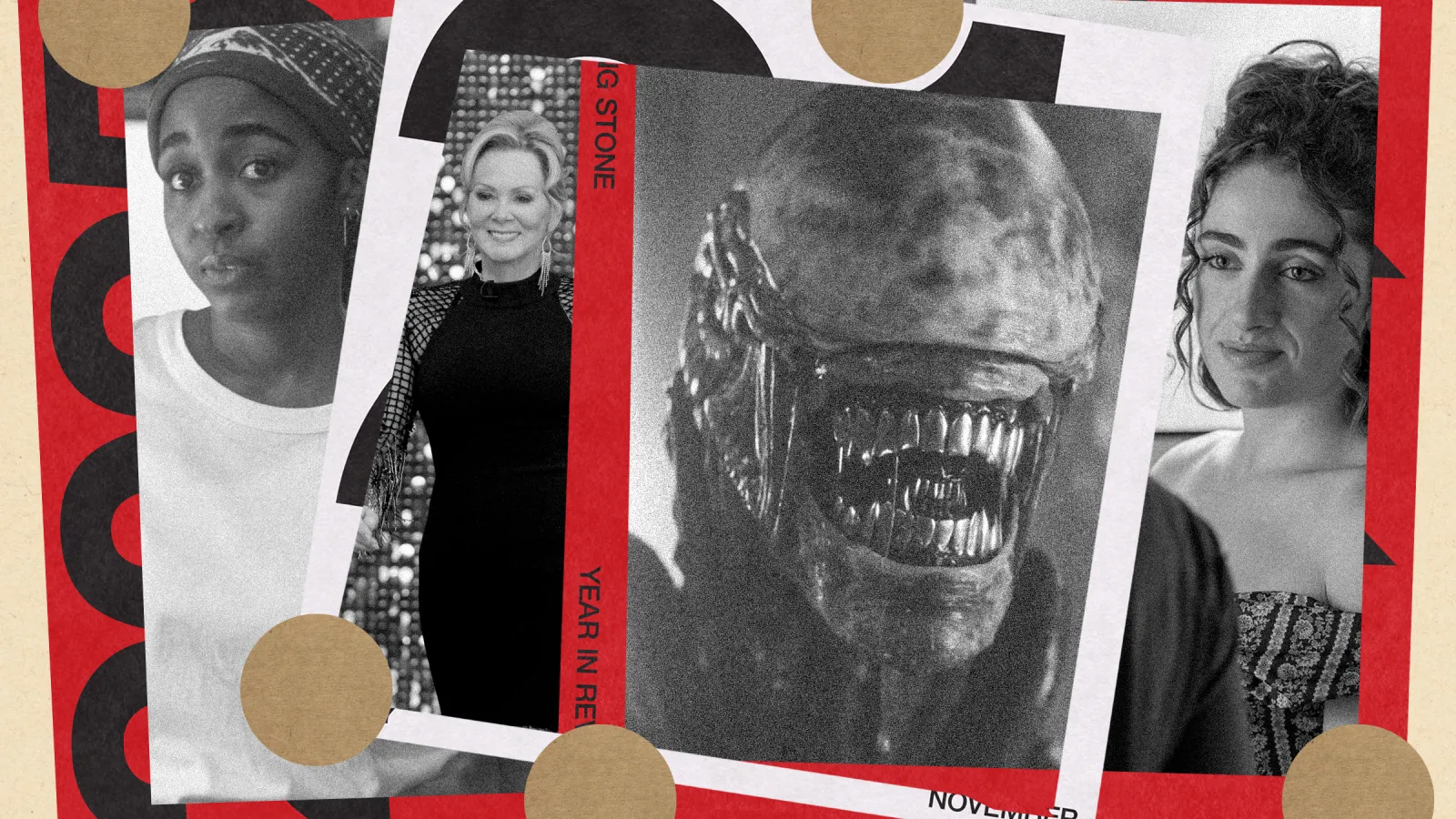

From thrashing headbangers to thumping club tracks to ethereal ballads, these 10 songs soundtracked key music moments in our favorite series this year
Carmela walking into Holsten’s diner to kick off the final scene of The Sopranos. Marissa shooting Trey on The O.C. Some of the biggest moments in TV history land that much harder because of the songs that soundtrack them. (In the case of the aforementioned, that would be Journey’s “Don’t Stop Believing” and Imogen Heap’s “Hide and Seek,” respectively.) A perfect needle drop can bring a whole new dimension to our favorite shows — and bring fans new and old to the songs and artists that music supervisors pluck from vast catalogs. Classic tracks find new audiences or spark fond memories for longtime listeners. Artists who rarely get the spotlight have viewers grabbing their phones and launching Shazam before the moment passes. Sometimes, series even commission original songs for key sequences, introducing fresh music to the TV-watching masses. This list of the standout TV needle-drop moments of the year features a little bit of all of the above.
Photographs In Illustration
FX, 2; MAX; Kenny Laubbacher/HBO
-
‘The Studio’: Gordon Lightfoot, “If You Could Read My Mind”


Image Credit: AppleTV The Studio swept this year’s Emmys, including outstanding music supervision for Gabe Hilfer. Playing off of the series’ uptempo, jazzy score, Hilfer sprinkles in a healthy dose of classic songs that once anchored well-known films (think Dean Martin’s “Ain’t That a Kick in the Head” from the 1960 Ocean’s 11). The effect is a bridge to Old Hollywood. And the triple placement of Gordon Lightfoot’s 1970 breakup ballad “If You Could Read My Mind” in Episode Three, “The Note,” lands every time. The first use comes during an executive screening of a Ron Howard film, where the song rolls over the movie’s superfluous, self-indulgent closing scene as Seth Rogen’s studio head Matt Remick and his team sit in slackjawed stupors. The mournful tune returns as a comedic underscore after Howard and Remick have nearly come to blows over Ron’s shitty ending, cueing up as a broken Remick trudges through his company’s Egyptian tomb-inspired offices and out onto the rooftop. The final callback: Howard calls Remick to agree with his note about the film’s bloated conclusion — but ends the exchange with, “Cross me again, I’ll fucking destroy you.” Cue Gordon’s lament (“I don’t know where we went wrong/but the feeling’s gone and I just can’t get it back…”) over the end credits.
-
‘The Bear’: St. Vincent, “Slow Disco”

Image Credit: FX After a few beeps of a digital clock, Episode Three, “Scallop,” segues into St. Vincent’s haunting 2017 song “Slow Disco,” which plays almost in full during an extended opening scene where Chef Sydney (Ayo Edibiri) meticulously prepares one dish in the solitude of the Bear kitchen before anyone else has arrived. The camera sweeps over and around Sydney, moving in close on her hands and panning the stove and countertop as the song’s strings rise and fall — a perfect harmony of intimate sounds and visuals. Music supervisors Christopher Storer and Josh Senior (also creator and executive producer, respectively) like the song so much they brought it back for the season finale. After Carmy (Jeremy Allen White) has handed over the restaurant to Syd and the kitchen clock counts down to zero in the empty, darkened restaurant, the low hum of the 2018 version, “Fast Slow Disco,” kicks in and carries through the closing credits.
-
‘Hacks’: SG Lewis and Loods, “Paradise”

Image Credit: Kenny Laubbacher/Max In the aptly titled episode “What Happens in Vegas,” a Las Vegas work trip for the Late Night With Deborah Vance writers quickly turns into full-blown debauchery. A slick drug dealer hops onto their party bus and snaps open a chic briefcase packed with party favors as SG Lewis and Loods’ base-thumper “Paradise” plays. A peak-time number, its almost unintelligible refrain of “all your loving is” ramps up the energy, the volume blasting as Deborah (Jean Smart), her head writer Ava (Hannah Einbinder), and the rest of the team step into a neon-lit club, dancing in slow motion. Once they reach the front of the stage, the DJ pulls them up to take over the decks. “Paradise” sits neatly between Yolanda Be Cool and DCUP’s “We No Speak Americano (Edit)” and Jamie xx and Robyn’s “Life,” which helps this already music-heavy episode glide with the ease of a well-paced Vegas DJ set.
-
‘Severance’: The Stone Roses, “Love Spreads”

Image Credit: Jon Pack/AppleTV This series is driven primarily by Theodore Shapiro’s powerful, piano-focused score, but Madchester originators the Stone Roses take over the early moments of the episode “Who Is Alive?” When Harmony (Patricia Arquette) pushes a cassette into her car stereo and pulls out onto a desolate icy road, the heavy grooves of “Love Spreads” blast from the speakers. Its guitar jangle continues over scenes of Mark (Adam Scott) getting ready for work and pulling his rundown Volvo into Lumon Industries’ parking lot, the song’s urgency building as he clicks his watch into stopwatch mode and runs toward the building. Its cadences mirror the action, quieting while Mark counts during the elevator’s ascent and rising in volume as his tension climbs. The placement lands with extra weight given the recent death of the band’s bassist, Gary “Mani” Mounfield.
-
‘I Love LA’: Peaches, “Boys Wanna Be Her”

Image Credit: Kenny Laubbacher/HBO The newest Sunday night must-watch on HBO Max is packed with earworms. Much of the pilot follows the unraveling of Maia Simsbury’s and Tallulah Stiel’s (Rachel Sennott and Odessa A’zion) bicoastal friendship. After they finally break the tension with a heart-to-heart in the bathroom at Maia’s birthday bash, the besties emerge and rejoin the party to the high-octane blast of Peaches’ empowerment anthem “Boys Wanna Be Her.” The 2006 banger plays as the drunk partygoers throw cash at a male stripper and influencer Tallulah strikes a racy pose for Maia’s camera — as the scene cuts to black for credits, it’s pretty clear who everyone wants to be.
-
‘Malice’: Ashnikko, “Cheerleader”

Image Credit: Prime There are many well-placed songs in this limited-series thriller, including its theme: “Blame” by Gabriels. But none works harder than Ashnikko’s trap/rap/brat pop “Cheerleader” in the second episode. The song does double duty when it tears through a strip club scene where Adam Healey (Jack Whitehall) has taken Jamie Tanner (David Duchovny). The verses mirror the women in the room (“game face on, hit the pose like perfect”), and the pre-chorus chimes like a Christmas carol before dropping into the relentless chant — “cheerleader, cheerleader, cheerleader, cheerleader” — that echoes Adam urging Jamie to drink more and more.
-
‘Black Rabbit’: Fontaines D.C., “Boys in the Better Land”

Image Credit: Netflix Considering brothers Jake and Vince Friedken (Jude Law and Jason Bateman) were once in a band together — called, wouldn’t you know it, Black Rabbit, just like their restaurant — music underscores this series at every turn. The show features two new songs from the Strokes’ Albert Hammond Jr., with vocals from Law. (One of them, “Turned to Black,” even comes with a long-lost music video from the brothers’ fictitious band.) There are also two gems from Irish post-punk rockers Fontaines D.C. The first, the propulsive “Boys in the Better Land,” blasts as Vince strides into a high-stakes poker game on an upper floor of an office building and slams a borrowed $2,500 in front of the cashier, who slides over a stack of chips. The track hollers over the entire scene in the episode “The Black Rabbits,” its adrenalized drums and deadpan vocals drowning out the room’s ambient noise as Vince, an inveterate gambler whose antics have embroiled the brothers in deep shit, tries to win himself $150K. Fontaines bring that same shout on “Starburster,” which kicks in as Vince runs off with, what else, a bag of cash in Episode Seven.
-
‘Alien: Earth’: Metallica, “Wherever I May Roam”

Image Credit: Patrick Brown/FX The sci-fi horror arcs of Alien: Earth are amplified by major songs from superstar rock bands during the end credits, pushing each cliffhanger even further. The lineup includes Black Sabbath, Jane’s Addiction, Tool, Godsmack, Smashing Pumpkins, Queens of the Stone Age, Pearl Jam and, most strikingly, Metallica. The thrash legends’ standout track “Wherever I May Roam” closes “Metamorphosis,” an especially gory and unsettling episode filled with squelching sound effects as one Xenomorph dies and another is born. Wendy (Sydney Chandler) collapses when she receives the Xenomorph eggs’ signals, hitting the ground and convulsing to the ominous sound of “Wherever I May Roam.”
-
‘Nobody Wants This’: Finneas, “Palomino”

Image Credit: Erin Simkin/Netflix The needle drops in the Netflix hit Nobody Wants This play like a tightly curated pop playlist, with all the current stars represented: Chappell Roan, Selena Gomez, Alessia Cara, Dermot Kennedy, Towa Bird, and Finneas, who wrote the roots-rock track “Palomino” for the series soundtrack. The song stands alone in “The Unethical Therapist,” which features only score cues otherwise. By this point in the second season, Joanne (Kristen Bell) and Noah (Adam Brody) are moving forward in their relationship. The episode focuses on Joanne’s dysfunctional family, and “Palomino” arrives at the end after Noah gives a moving sermon that signals his departure from this particular temple. With its country inflections and clean production, “Palomino” carries him out with grace.
-
‘Pluribus’: Murat Evgin, “Nobody Told Me”

Image Credit: Jeff Neumann/AppleTV The song use is spare in Vince Gilligan’s latest series, but each choice carries weight. A prime example is Turkish musician Murat Evgin’s Middle Eastern-tinged, native-language cover of John Lennon’s “Nobody Told Me,” which music supervisor Thomas Golubić tells Rolling Stone was commissioned specifically for the end credits of the “Pirate Lady” episode. While it may not be immediately clear to viewers why the creative team wanted a Turkish version of this song, there is a payoff down the line: In the next episode, Carol Sturka (Rhea Seehorn) repeatedly calls another immune character, Manousos Oviedo (Carlos-Manuel Vesga), at his home in Paraguay. This leads directly into the following episode’s cold open, which plays out from Manousos’ point of view as he receives those calls and hangs up on Carol. When she finally manages to say her name before he slams the receiver down again, he writes it out: “Carol Es Turka,” which translates from Spanish as “Carol is Turkish.”