



The movies tend to do better in depicting agony over ecstasy, but The Testament of Ann Lee drops a potent depiction of the latter early on. We are in Manchester, in the early 1760s. Young Ann Lee (Amanda Seyfried) works as a cleaner in a hospital, and lives with her brother William (Lewis Pullman), and her late sister’s daughter. She is a pious woman, having felt the presence of God in her life from an early age. And having been forced, due to close living quarters, to bear witness to her parents rutting like farm animals in heat, she’s also developed conflicted ideas about the pleasures of the flesh. Ann and her kin are drawn to a religious community that has separated themselves from both the Church of England and the burgeoning countermovement known as the Methodists. These “shaking quakers” are a sect to themselves.
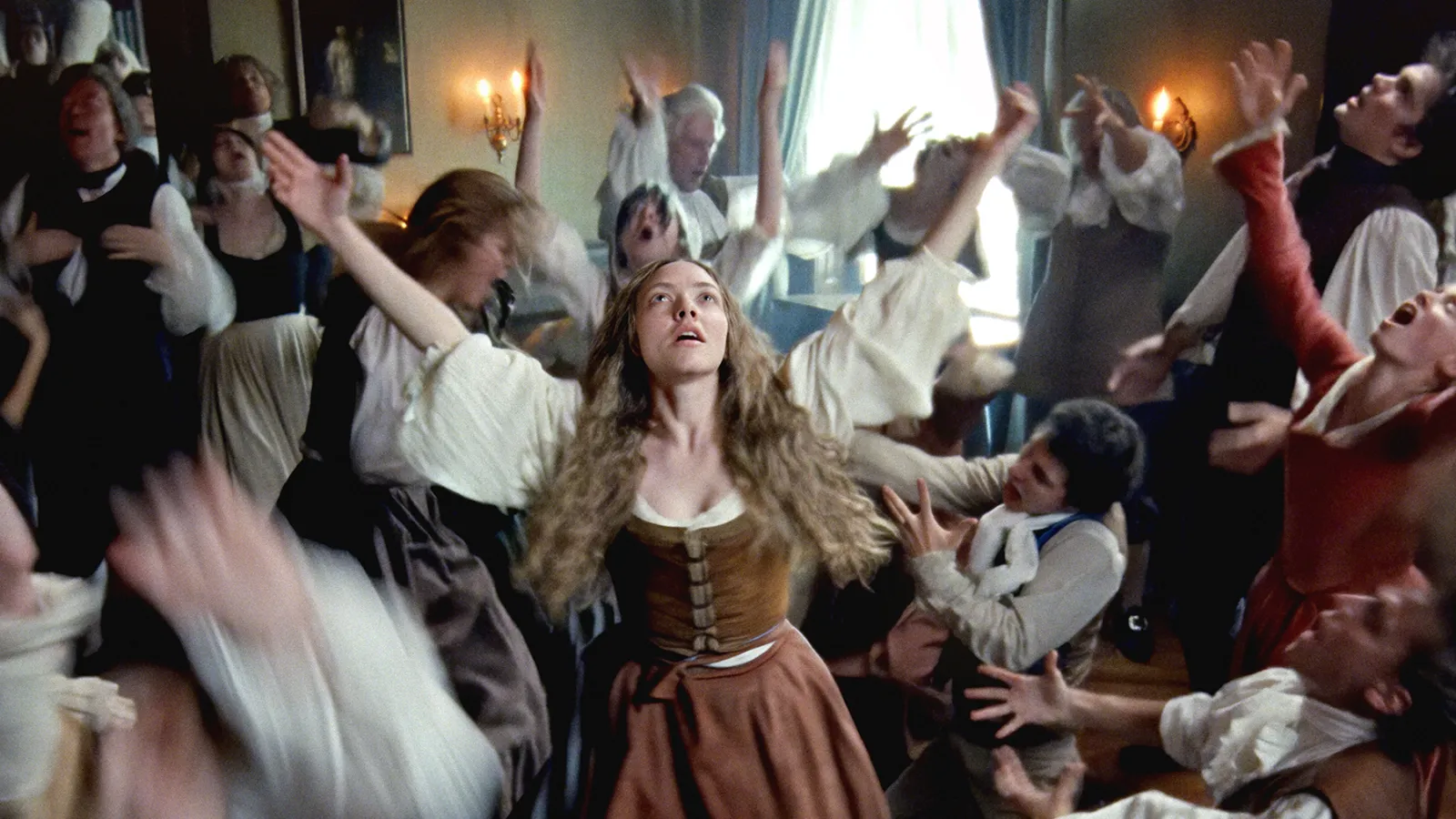
They commune via prayer and unburden by the confessing of sins. Yet their worship does not stop there. The Shakers, as they’ll eventually be named, channel the holy spirit via song and dance. Ann Lee embraces this practice with the fervor of a true believer. So naturally, in recounting this woman’s story — a tale in which we follow Lee as she spreads the good word, gathers converts, and leads her followers to a feral, often unfriendly place soon to be dubbed “America” — filmmaker Mona Fastvold drops us right into the middle of the Shaker equivalent of mass. The congregation writhes, sometimes in unison, and whirls and stomps; at one point, a line of folks snake through a doorway and into the foreground, as the camera rotates in the opposite direction. They beat their hands against their chests and raise their arms heavenward, twitching like marionettes on strings. Their hymn keeps time via a full-body rhythm. A close-up of Ann’s face as her head whips back testifies to the sheer joy she feels in testifying to the Lord. Fastvold is crafting a biopic, but she’s borrowing the trappings of a genre far better equipped to portray spiritual transcendence: the movie musical.
For those of us who’ve had something close to a religious experience while watching, say, Singin’ in the Rain or Gold Diggers of 1933, the choice to use musical numbers to portray a person in thrall to complete abandon is a no-brainer. And while it’d be foolhardy to expect that this will inspire a resurgence of interest in Shaker songs and dances à la O Brother Where Art Thou‘s mainstream revival of bluegrass music a quarter of a century ago, both choreographer Celia Rowlson-Hall and composer Daniel Blumberg definitely make you see the transportive power of these ancient customs. Not all of the film’s numbers deliver the primal joy of bodies moving chaotically through the frame, yet the few full-blown examples of 18th century everyday people losing themselves to the holy-roller beat carries this film even more than the meticulous historical recreations. It’s a period film with 6/8 pulse.
After Ann finds what she’s looking for amongst the Shakers, she begin to see visions: angels, serpents, a land across the Atlantic that will allow their cause take root. She also ceases the practice of fornicating with her blacksmith husband Abraham (Christopher Abbott), much to his dismay. Their union led to the conception of four children, all of whom died shortly after birth. Ann believes her sins led to their untimely demise. She wants to honor her marital duties, but there is a higher calling to answer to. The Shakers must save all of their love for God. Not even arrests, violence or the nagging sensation known as lust can sway them.

Stacy Martin, Thomasin McKenzie, and Lewis Pullman in ‘The Testament of Ann Lee.’
Searchlight Pictures
Once Ann, her brother and niece, and a small congregation that includes our humble narrator, Sister Mary Partington (Last Night in Soho‘s Thomasin Mackenzie), land in the New World right before it becomes a sovereign nation, The Testament of Ann Lee becomes a true American story. Which means that it becomes, among other things, a parable of persecution, as the freedoms promised by these former colonies butt up against the prejudices and populist notions of might over right. Will’s missionary work turns the Shakers into a movement and the source of some truly excellent furniture. Ann’s declaration that no Shaker shall “take up a sword against the Devil,” by which she means British troops trying to squash a revolution, gets them brand as treasonous. Cue the agony. It will end badly for the group, even if the movie itself ends with a Busby Berkeley overhead shot that feels positively beatific.
Fastvold previously cowrote The Brutalist with her professional/personal partner, director Brady Corbet (he helped pen this script, while she took over directorial duties), and like that woozy epic conjuring up the spirit of the New Hollywood saints, the attention to detail here — combined with a high degree of difficulty in blending the biographical and the tunefully divine — is a tribute to its creators. The similarities to Fastvold and Corbet’s Oscar-winning chronicle of an immigrant’s rise and fall, however, don’t stop there. The Testament of Ann Lee is really about having an extraordinary sense of commitment to chasing your vision, be it for spiritual awakening or artistic endeavors that fly in the face of the Entertainment Inc. market, to illogical and extreme ends. That goes double for its star, who throws herself into the role with a unihibitedness and a dedication that Lee would find admirable.
To watch Amanda Seyfried sing so devotionally for a world beyond this one is to see a portrait of someone desperately searching for a semblance of heaven on earth. (This is not to be confused with what she’s doing in her other movie out right now, The Housemaid, which focuses on women stuck in a perpetual life of hell. ‘Tis the Seyfried season!) It’s easy to just bask in the magic-hour imagery, the artisanal spectacle of dancers throwing themselves about, and the overall effort it took to recreate a 18th century America experiencing early growing pains. All of that alone is an accomplishment. Seyfried reminds you this is human story of hunger and thirst — literally, in the case of Blumberg’s number “Hunger and Thirst.” The movie isn’t just a paean to a pioneer spirit. It’s equally a testament to the actor playing her.
